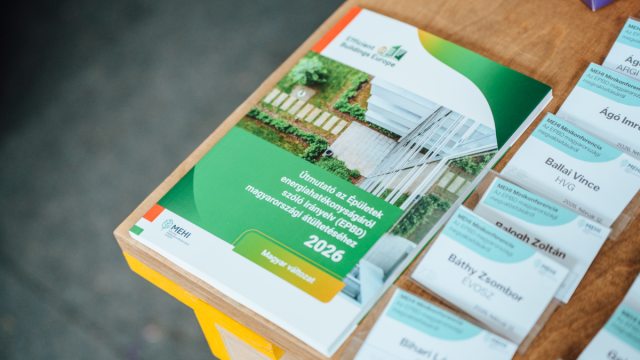

On February 12, MEHI presented its free publication titled Guide to the Hungarian Implementation of the Energy Performance of Buildings Directive (EPBD) at the Hungarian Contemporary Architecture Centre (KÉK), attracting wide professional interest. Prepared with the contribution of Hungarian and European experts, the guide provides a detailed overview of the EU directive that Hungary must transpose into national law by spring 2026, and which will fundamentally shape the renovation, operation, and construction of the Hungarian building stock in the coming decades.
The central message of the publication is that energy savings are not a burden, but an opportunity for Hungary. Improving the energy efficiency of buildings can significantly reduce dependence on natural gas imports and exposure to volatile energy prices. According to estimates, the deep renovation of 100,000 buildings could result in an annual reduction of approximately 500,000 tonnes of CO₂ emissions, create tens of thousands of jobs—primarily within domestic small and medium-sized enterprises—and improve the health of residents and workers. Renovation does not merely offer one-off reductions in utility costs, but delivers long-term energy security, healthier indoor environments, and a more resilient and sustainable building stock.
The publication provides a detailed overview of several key topics within the directive. For each topic, it explains the requirements set by the directive, outlines the resulting recommendations, and highlights leading countries in the given field. In this way, it simultaneously explains the content of the EPBD, presents international best practices, and offers guidance for national interpretation, as introduced by Anikó Pálffy, Policy Head at MEHI. The guide formulates a total of fifty recommendations across five major thematic areas to support the transition towards a more energy-efficient building stock.

The guide emphasizes that the EPBD is not a set of detailed rules, but rather a framework that allows significant national flexibility in terms of timing, priorities, and implementation models. As highlighted in the foreword by Áron Horváth, Managing Director of MEHI, forward-looking implementation based on a credible plan is politically, economically, and socially more advantageous than delayed adaptation. Therefore, the domestic implementation of the EPBD is not merely an EU obligation, but also an investment in energy independence and economic policy.

One of the key topics of the guide is the future requirement level for zero-emission buildings. This will become a defining requirement for new buildings in the coming years and will, in the longer term, underpin the transformation of the entire building stock. The document also discusses the potential of smart building solutions to deliver up to 30% energy savings, as well as the gradual phase-out of fossil-based heating systems. The guide places particular emphasis on the renovation of the worst-performing buildings, which is simultaneously a climate, social, and public health issue. In the future, the energy performance certificate will evolve into a Building Renovation Passport, outlining the steps and proper sequencing of renovation, thereby supporting staged and well-planned upgrades.

Participants in the first roundtable discussion—Zsuzsa Szalay (BME), Zsuzsa Koritár (Habitat for Humanity Hungary), Károly Oelberg (AACM), and Gábor Szarvas (HuGBC)—highlighted that renovation programmes must be launched as soon as possible, even if they are not perfect. According to the participants, energy efficiency is the primary tool for decarbonisation, and for each building, actions should be based on proper assessment, the correct sequencing of interventions, and a long-term goal of achieving zero-emission buildings. Gábor Szarvas emphasized that the Hungarian professional community—designers, contractors, manufacturers, and real estate developers—is already actively preparing for the EPBD and, in many respects, is ahead of regulation. Zsuzsa Szalay stressed the importance of clearly distinguishing between socially targeted renovation programmes and measures aimed at those who could finance upgrades from their own resources. She also highlighted that subsidies should be linked to measurable indicators, such as CO₂ and energy savings, and should integrate air quality and social considerations. Zsuzsa Koritár pointed out that around one-third of households rely on wood-based heating, which is currently insufficiently addressed by decarbonisation measures, despite being among the most critical sources of air pollution. It was emphasized that the green transition must not leave behind the most vulnerable groups.

Barbara Réthelyi, Head of Department at the Ministry of Energy, presented the status of preparations for the National Building Renovation Plan (NÉT). In her presentation, she highlighted that the new EU regulatory framework—including the EPBD, the Energy Efficiency Directive, and the Renewable Energy Directive—requires more comprehensive, concrete, and time-bound measures from Member States. The NÉT is not merely an administrative obligation, but an opportunity for Hungary to define a long-term pathway based on deep renovations. As buildings account for approximately 40% of total energy consumption, their modernization is a key issue for achieving climate goals, energy independence, and competitiveness.

Participants in the second roundtable—Gábor Kovács (VELUX), Gábor Csokló (Masterplast), Tamás Aszódy (Knauf Insulation), and István Pécsi (Daikin)—agreed that while the direction of regulation is clear, the key to success lies in predictability, a stable support environment, and the involvement of professional stakeholders.
The presentation shown at the event is available (in Hungarian) via this link.