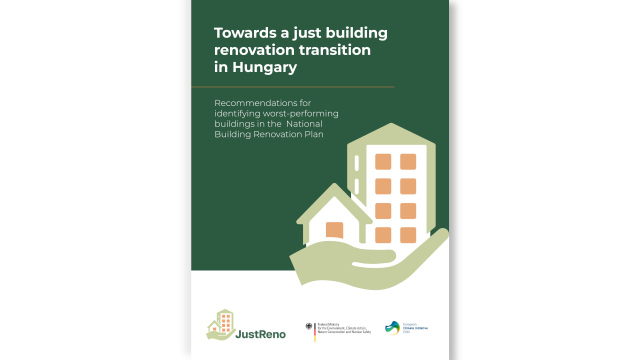

We are pleased to announce the release of our latest publication, On the Path Towards an Energy-Efficient Building Stock (currently available in Hungarian only). This handbook is aimed at Hungarian municipalities and presents, through numerous best practice examples, how local governments can comply with the new EU regulatory framework, what options are available when initiating building renovation projects, and what kinds of cost savings can be achieved.
In recent years, the European and national regulatory environment has undergone significant transformation. New energy efficiency requirements, obligations, and planning expectations have emerged, directly affecting municipalities and local building stocks. The aim of this handbook is to provide municipalities with a clear and practical guide to understanding and addressing the new building-related responsibilities and requirements under the EU’s Fit for 55 package.
The publication is based on more than 25 interviews, recommendations from professional organizations, and the experiences of municipalities. At its core are 20 case studies developed with municipalities of varying sizes and characteristics. These case studies present real-world local practices, including quick, low-investment energy-saving measures, building renovation projects, residential incentive programs, renewable-based heating developments, and innovative financing solutions.
Municipalities face not only new obligations but also significant capacity and information gaps. Many lack comprehensive building inventories, systematic energy consumption data collection, sufficient numbers of qualified energy experts, and adequate financial resources. Therefore, effective preparation requires strengthening local capacities, long-term planning, and informed, data-driven decision-making.
The handbook identifies four key areas where municipalities have meaningful leverage to improve building energy efficiency:
- Improving energy management: monitoring, building automation, energy management systems, and interventions that deliver quick and measurable results
- Promoting the renovation of municipal and residential buildings: exemplary projects, local support schemes, awareness-raising, and one-stop-shop advisory models
- Reducing heating energy demand and transitioning to renewables: local heating and cooling planning, district heating development, geothermal and heat pump solutions
- Financing: national and EU funding sources, innovative financing models, including the use of Energy Efficiency Obligation Schemes (EEOS)
Our key conclusion is that technical solutions are essential but not sufficient on their own. Success depends on strengthening local institutional capacity, long-term planning, consistent implementation, and community engagement. The examples clearly show that successful municipalities always have a committed leader and a responsible expert who drives projects forward. Preparation is not only a technical or financial issue, but also an organizational and strategic one.
The handbook also asserts that energy efficiency is no longer optional: an increasing share of requirements is becoming mandatory, while also offering strong economic returns. Municipalities will become more resilient, sustainable, and economically stable if they treat the energy transition as a strategic priority. The 20 Hungarian case studies demonstrate that this shift in approach is not only necessary but achievable—whether in small towns or large cities.
The publication is available for download via this link (in Hungarian only).