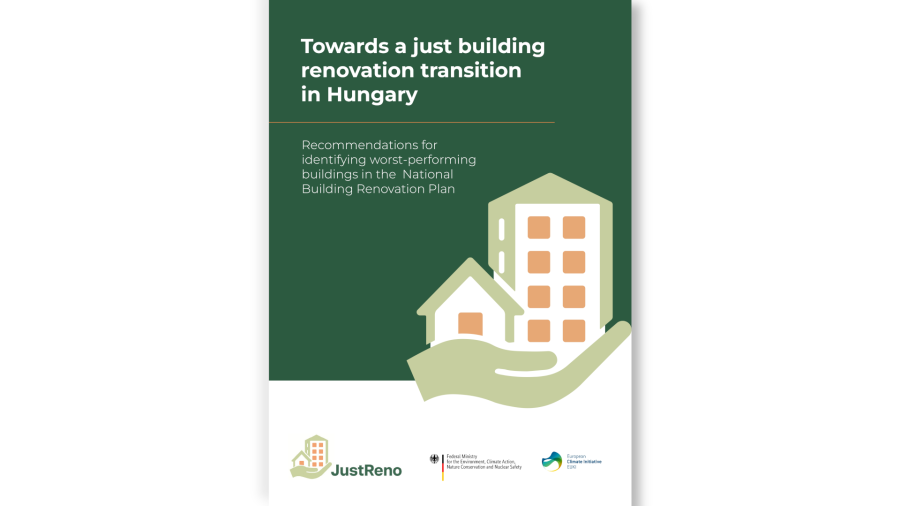
MEHI’s new report, prepared within the framework of the JustReno project, examines from the perspective of Hungary’s forthcoming National Building Renovation Plan (NBRP) how the worst-performing buildings can be identified and where these overlap with the most vulnerable households.
It is essential that the building renovation wave, a key part of the climate transition, is fair and inclusive. This requires identifying worst-performing buildings (WPBs) based on the definition set out in the new EU Energy Performance of Buildings Directive (EPBD) and the data currently available in Hungary.
Our JustReno project, funded by EUKI, aims not only to identify these buildings, but also to explore their overlap with the most vulnerable households: which homes in Hungary combine the poorest energy performance with the highest levels of household vulnerability. Our project partners are BPIE, Ae3R Ploiesti-Prahova and ROENEF.
Our analysis highlights several important findings:
- Nearly half of Hungary’s residential building stock is a WPB. More than two-thirds has poor energy performance, with an energy rating of F or worse.
- The challenge is concentrated mainly in rural areas: almost four-fifths of Hungary’s WPBs are located in villages and smaller towns, and the overwhelming majority are single-family houses.
- The situation in Budapest and major cities differs from that in rural areas, but many buildings there are also in need of renovation. In Budapest, around 117,000 dwellings in multi-family buildings are WPBs, accounting for more than half of all multi-family WPBs nationwide.
- Social vulnerability and poor energy performance are strongly correlated, but they do not fully overlap. Vulnerable households are more likely to live in WPBs, but many higher-status households also live in homes with poor energy performance, particularly in urban areas. The overlap between the two groups is therefore substantial, but not complete.
- Heating type is strongly associated with energy performance. Nearly 90% of dwellings heated exclusively with wood are WPBs, many of them located in rural areas. Wood-based heating in Hungary typically relies on outdated heating systems: without improving the energy performance of these homes, the problem of energy waste cannot be effectively addressed.
- Strengthening the role of municipalities requires clearer responsibilities, targeted capacity building, better data-sharing mechanisms, and regulatory and incentive frameworks that support their active involvement in the renovation of privately owned residential buildings.
- The NBRP can only be socially just and effective if it takes into account territorial differences, regulatory constraints, and the complexity of the overlaps between energy and social vulnerability.
- The NBRP should be embedded in a coherent strategic ecosystem. Alignment with the Social Climate Plan, the National Energy and Climate Plan, local SECAPs, and heating and cooling plans should ensure that renovation effectively contributes to Hungary’s climate security, energy security and social objectives.
The full analysis is available in English here.